SIKE was constructed on supersingular isogenies, a development proposed by David Jao and Luca De Feo in 2011, and it was prized for having by far the smallest keys of any post-quantum candidate. It survived a decade of public scrutiny and advanced to the fourth round of the NIST course of. Each requirements spend most of their time multiplying polynomials, and doing that naively costs numerous operations proportional to the square of the diploma.
- Schemes constructed on lattice-based cryptography are not unusually fragile, they usually do have a distinctive risk profile.
- Secondly, Eve may try to discover out the message mm directly from the ciphertext cc with out finding GG.
- Just like hiding PKCS #1 v1.5 failures in RSA decryption, Kyber must hide decapsulation failures.
- There is no natural hidden interval in a lattice for the Fourier remodel to show, and the group structure that makes Shor’s algorithm work is absent.
- They need nothing except that a hash function behaves like a hash function, with no number theory, no lattices and no construction an algebraist could attack, which implies they inherit whatever confidence the community has in SHA-256 and nothing extra.
Lattice-based Strong Designated Verifier Signature With Non-delegatability
NIST said that the algorithms not chosen are not into consideration as half of the current course of, which retired BIKE, Classic McEliece and SIKE from the American requirements monitor in a single sentence. The call printed in September 2022 encoded that choice as a rule. A lattice-based submission had to offer a minimal of one giant performance benefit over each Dilithium and Falcon to be considered at all, whereas a non-lattice submission only had to provide one giant advantage over the existing selections. The isogeny household has had the roughest decade and has not left the sector. Its objects are supersingular elliptic curves and the maps between them, and its selling point was all the time measurement, since an isogeny public key could be a few hundred bytes when every thing else was measured in kilobytes. Unbalanced Oil and Vinegar, the older and simpler design Rainbow had generalised, is untouched by the attack and is considered one of 9 schemes still in NIST’s signature process, alongside the newer MAYO, QR-UOV and SNOVA.
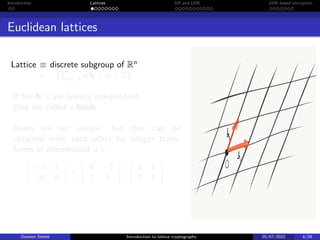
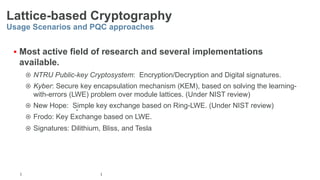
This paper will concentrate on both code-based and lattice-based systems and additionally will discover the connection between these two seemingly distinct cryptographic strategies. This equation can be used in the identical protocol as we did with the usual LWE the place s is still the non-public key and b is the public key, but now they are polynomials as a substitute of vectors and matrices. ML-KEM is a key encapsulation mechanism, standardised in FIPS 203 and derived from CRYSTALS-Kyber, used to agree a shared secret over an open channel. ML-DSA is a digital signature scheme, standardised in FIPS 204 and derived from CRYSTALS-Dilithium, used to prove that a message got here from a specific key holder. Crypto-agility means the ability to change algorithm without changing the system around it, whether the substitute is extra lattice-based cryptography or one thing else, and it is principally a listing and architecture downside rather than a cryptographic one.
Key And Signature Sizes Throughout The Standards
HQC’s failure fee has a closed-form sure, and the report says plainly that this stable analysis was the decisive factor. NIST wanted a KEM that did not rest on lattices in any respect, and in March 2025 it selected one. HQC, standing for Hamming Quasi-Cyclic, is code-based like Classic McEliece however built on a unique precept, and the fourth-round standing report describes it as a KEM by which no trapdoor is hidden in the code in any respect. The comparison is unflattering for lattice-based cryptography in one course and never within the different. An ML-KEM-768 trade moves about 2.3 kilobytes where X25519 strikes sixty four bytes, a factor of roughly thirty-five, and that site visitors lands within the very first round journey of a connection where latency is most visible.
24 Encryption And Decryption Instance
Its ciphertexts are unusually small in return, at ninety six and 208 bytes respectively. The Nationwide Safety Company runs its personal algorithm suite for national safety techniques, and its post-quantum version https://powermat.com/blog/fast-wireless-charging/ diverges from strange practice in an instructive way. The Industrial National Security Algorithm Suite 2.zero contains ML-KEM-1024, ML-DSA-87, AES with 256-bit keys, SHA-384 and SHA-512, and the stateful hash-based signature schemes LMS and XMSS. The submission stories block sizes of 406, 626 and 878 for the three parameter units, and multiplying by zero.292 gives 118, 183 and 256 bits of classical core-SVP hardness, which is where the security-category claims come from. The corresponding figures towards an attacker with Grover’s algorithm inside the sieve are 107, 166 and 232. The focus in that end result was recognised immediately as an issue.
The LLL algorithm of Lenstra, Lenstra and Lovász, revealed in 1982, finds a shorter and less skewed basis in polynomial time, and it’s genuinely highly effective. Its guarantee degrades exponentially with dimension, nonetheless, which is why parameters in lattice-based cryptography are chosen to sit down far past its reach. Having resisted decades of cryptanalytic attacks from both classical and quantum computer systems, the safety of code-based techniques such because the McEliece cryptosystem make them good candidates for post-quantum cryptography. Moreover, with ongoing efforts to reduce the key measurement of the McEliece cryptosystem, it may turn out to be crucial to the future safety of our digital info.
